Guide
Rug placement under a sofa or sectional
Updated September 8, 2026
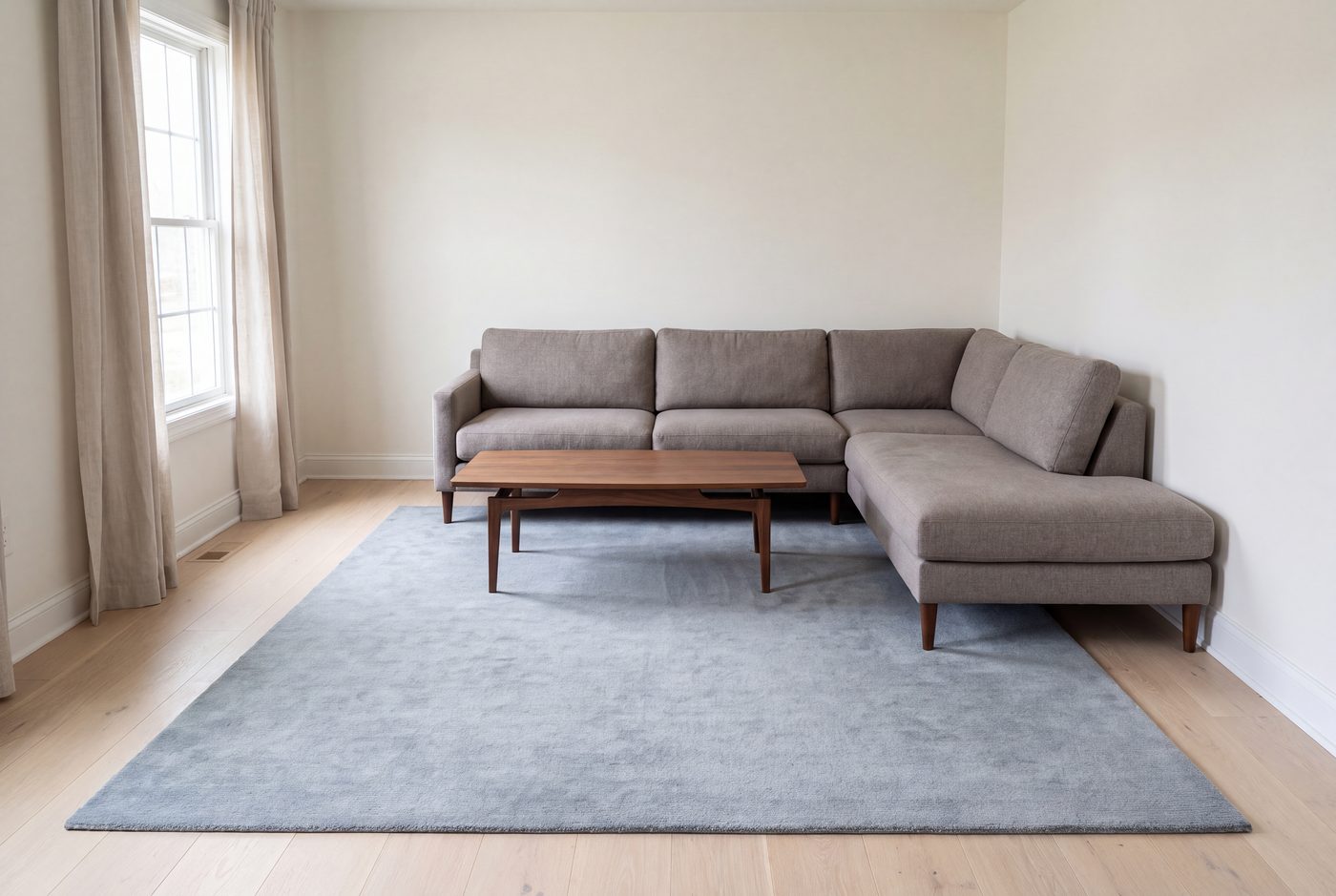
Three layouts work under a seating group. Which one you can use is decided by how much floor the room has, and the choice changes the rug size by a foot or two in each direction.
The three layouts
All legs on. Every piece of seating stands entirely on the rug. The most settled of the three, and the one that needs the most floor. In a standard living room this is a 10 x 14.
Front legs on. The front legs of the sofa and the chairs sit on the rug, the back legs on the floor. The rug still gathers the group, and it costs a size less. This is the layout to default to. An 8 x 10 or a 9 x 12 in most rooms.
All legs off. The rug floats in the middle with the coffee table on it and the seating around it on bare floor. It works in a small room or an apartment, and only when the rug still reaches close to the furniture. A small rug marooned in the middle of a large floor is this layout failing.
Shop 9 x 12 · Shop 8 x 10 · Shop 10 x 14
Sectionals
An L-shaped sectional is deeper than a sofa and turns a corner, so the floating layout is out: a rug that clears both runs of the L is already large enough to be under them.
Run the rug under the front edge of both arms of the L. Follow the shape of the sectional rather than the shape of the room, and let the rug extend past the open end so the group is closed on three sides.
A chaise or an ottoman on the open end should stand on the rug with the rest. A sectional with one piece on the rug and one piece off is the layout reading as an accident.
Sectionals commonly run 100 to 120 inches along the long side, so a 9 x 12 is the usual starting point and a 10 x 14 is what a large one needs.
Should the rug be longer than the couch
Yes, and by 6 to 12 inches at each end. A rug that stops level with the arms of the sofa makes the sofa look too big for it, and the eye reads the pair as mismatched before it works out why.
A standard three seat sofa is 84 inches wide, so the rug wants to be 96 to 108 inches across, which is an 8 x 10 or a 9 x 12. That single measurement decides most living room rug purchases, and it is the one people skip.
The same applies to depth: the rug should reach far enough forward that the coffee table sits entirely on it with clear rug showing on the far side.
How the couch sits on it
In the two layouts that touch the furniture, only the front legs or all four are on the rug. There is no correct version where one leg is on and one is off, or where the rug edge runs under the middle of the sofa.
Front legs on is the default. Push the rug back until the front feet of the sofa are 4 to 8 inches inside the rug edge, so the rug does not creep out from under them over a few months of use.
A television wall
When the seating faces a television rather than another sofa, the rug still belongs to the seating group and not to the wall. Set it under the sofa and the chairs and let it stop before the media unit, which normally stands on bare floor.
A rug that runs under a media unit gets trapped by it, so it cannot be lifted or turned, and it wears in one line where everyone walks past.
A small living room
The floating layout is the honest answer in a room too small for anything else, and it works when the rug still reaches close to the furniture.
- Keep the coffee table entirely on the rug.
- Get the rug within a few inches of the sofa, even if nothing stands on it.
- A 5 x 8 is the usual size, and the room reads larger because the floor shows.
What fails is a small rug in the middle of a large floor with a gap on all sides. That is the same layout used in the wrong room.
Center it on the furniture, not on the room
The rug is centered on the seating group. If the group sits off to one side of a long room, the rug goes with it.
Centering the rug on the room while the furniture sits off center gives you two different margins that fight each other, and the eye reads the rug as crooked even when it is square to the walls.
The exception is a room where the seating is centered anyway, which is most rooms with a fireplace or a television on one wall.
Five things that read as wrong
- A rug narrower than the sofa. The most common one. See the living room sizing guide for the arithmetic.
- The coffee table half on. The table sits entirely on the rug in all three layouts. There is no version where it straddles the edge.
- Uneven borders. Bare floor should be roughly equal on the sides that show. Different by more than a few inches and it reads as a misplacement.
- A rug against a wall on one side. A rug should stop short of every wall unless it is deliberately running under a built-in.
- Fouling a door. Check the swing of every door into the room at its lowest point before buying, because a quarter inch is enough to catch.
Two rugs in one room
Layering a smaller rug over a larger one works when the two differ clearly in texture or tone, and when the top rug is centered on something, a seating group or a table.
Two rugs side by side in an open plan room should be different sizes or different shapes. Two similar rugs at a similar size read as one rug that has been cut in half.
Other rooms
Bedrooms have their own three placements and their own arithmetic, in the bedroom placement guide. Dining rooms are sized by the chairs pulled out, in the dining table guide.
What size do I need?
You need a 10' × 14'
Ideal is 10.0' × 14.0', which leaves about 18" of floor showing, and reaches under the front legs of every seat.
34 rugs in that size
Want the rug itself, not only the size? Try the Rug Finder: every room sized and shortlisted by color, look and budget.