Guide
How to clean a jute rug
Updated September 8, 2026
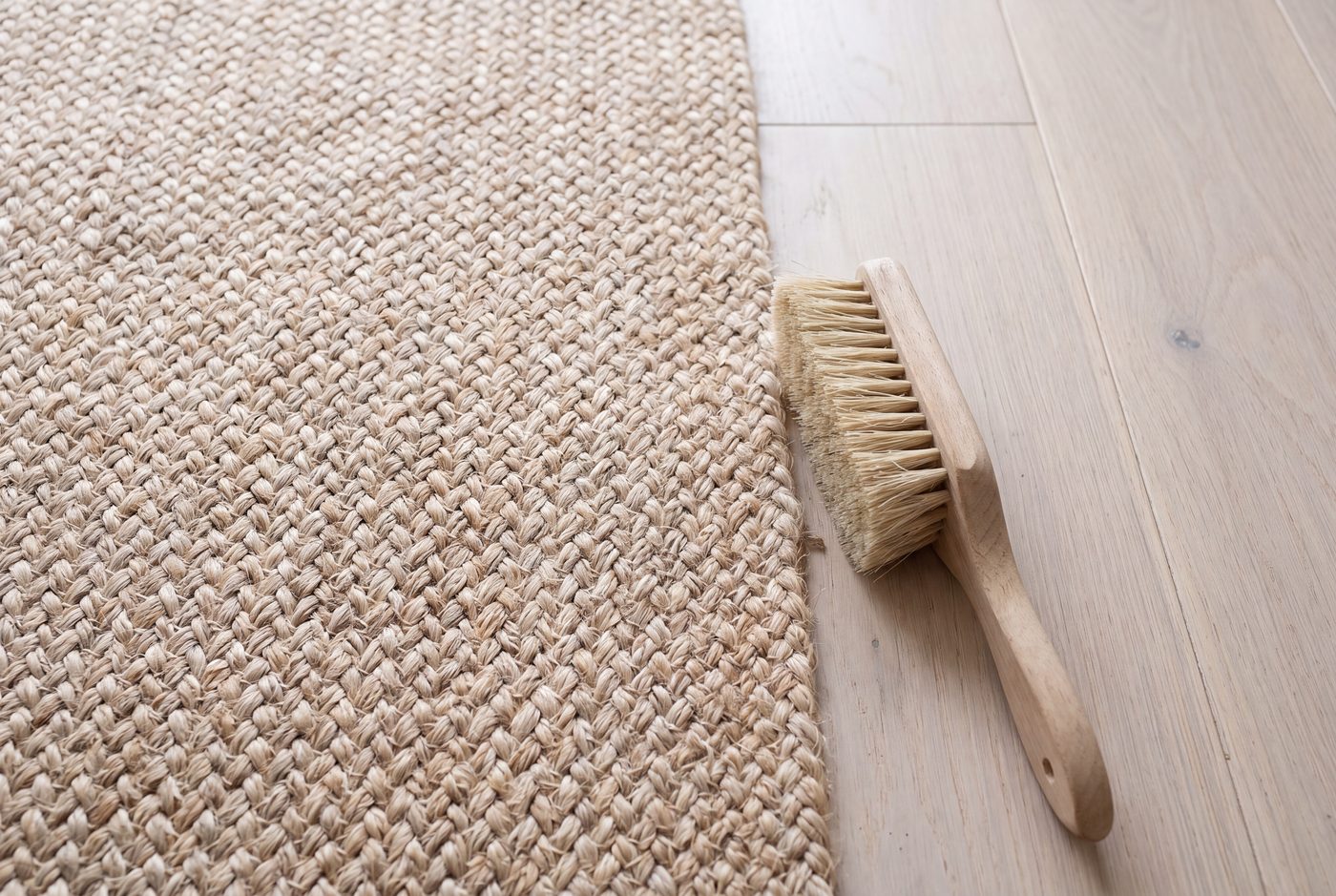
Jute is a plant fiber, and it behaves like one. It drinks water, it takes days to dry, and as it dries the natural tannins in the fiber travel with the moisture to the surface and leave a brown ring at the edge of the damp patch.
That ring is called cellulosic browning, and it is often more visible than the spill that caused it. So the rule for jute is the opposite of the rule for wool: use the least water that will do the job, and never soak it.
Dry methods first
Most jute cleaning is dry, and dry methods are the ones that carry no risk.
- Vacuum both sides, suction only, no beater bar. Jute is loosely woven and grit falls straight through the weave to the floor, so the underside and the floor beneath it hold as much dirt as the surface.
- Shake or beat a small rug outdoors. More effective on jute than on any pile rug, because the debris is sitting loose in the weave rather than caught in fibers.
- For a dry spill, scrape up the solids with a spoon edge, then vacuum. Do not add water at all.
- Baking soda left on an area overnight and vacuumed off lifts odor without moisture.
A wet spill
Speed matters more here than anywhere, because the goal is to remove the liquid before the fiber absorbs it.
- Blot immediately, pressing straight down with a dry white cloth. Keep moving to a dry part of the cloth.
- Keep blotting past the point where it looks done. Every gram of liquid you take out now is one that cannot travel back to the surface as a brown ring later.
- If you must use moisture, barely dampen the cloth with cold water and a drop of clear dish soap. Work the whole area between seams or the whole visible section rather than one small circle, so any tone change has no hard edge to read against.
- Dry it fast. A fan on the spot, or a hair dryer on cool. Drying speed is what decides whether a ring forms.
Never put a jute rug in a washing machine, never steam clean it, and never leave it rolled up damp.
Pet accidents
Urine passes straight through jute into the pad and the floor, so the rug is only half the problem.
Blot as much as possible, lift the rug, deal with the floor underneath, and dry both with air moving. An enzyme cleaner is what breaks down the odor compounds, and it needs to be used sparingly on jute and dried quickly. A jute rug that has taken a large accident is often not economically recoverable, which is worth knowing before putting one where a puppy lives.
Four questions people ask
- Does water ruin a jute rug? A small amount, blotted and dried quickly, does not. Soaking it does: the fiber swells, takes days to dry, and the tannins travel to the surface as it dries and leave a brown ring.
- Can you hose down a jute rug? No. That is the outdoor rug method, and it puts more water into jute than jute can lose before it browns or mildews.
- Can it be dry cleaned? Some can, and it is genuinely the safest deep clean for jute because it uses no water. Ask a rug specialist rather than a garment cleaner, and expect them to decline a rug that is already stained.
- Can you use vinegar? Sparingly. A mist of one part white vinegar to three parts water on a cloth, blotted and dried fast, helps with odor. Vinegar is a liquid like any other here, so the rule about drying speed still applies.
The downsides, stated plainly
Jute is inexpensive, hard wearing underfoot and looks like nothing else, and it has real limits worth knowing before it goes in a particular room.
- It does not like water, which rules out bathrooms, laundry rooms and covered porches.
- It sheds for the first few weeks and continues lightly after that.
- It is coarse underfoot. A jute rug is not a rug to sit on the floor on.
- Spills are harder to recover than on wool or polypropylene, because the safe method is the slow one.
Somewhere dry with normal foot traffic is where jute is at its best.
Sun, damp and shedding
- Jute fades in direct sun. Rotate it 180 degrees twice a year.
- It is an indoor fiber. Damp basements, bathrooms and covered porches will mildew it from the back.
- New jute sheds short fibers and smells faintly of hay for a few weeks. Both settle.
- A rug pad matters more under jute than under wool, because it keeps the coarse back off the floor and lets air move underneath.