Guide
Entryway and hallway runner sizing
Updated September 8, 2026
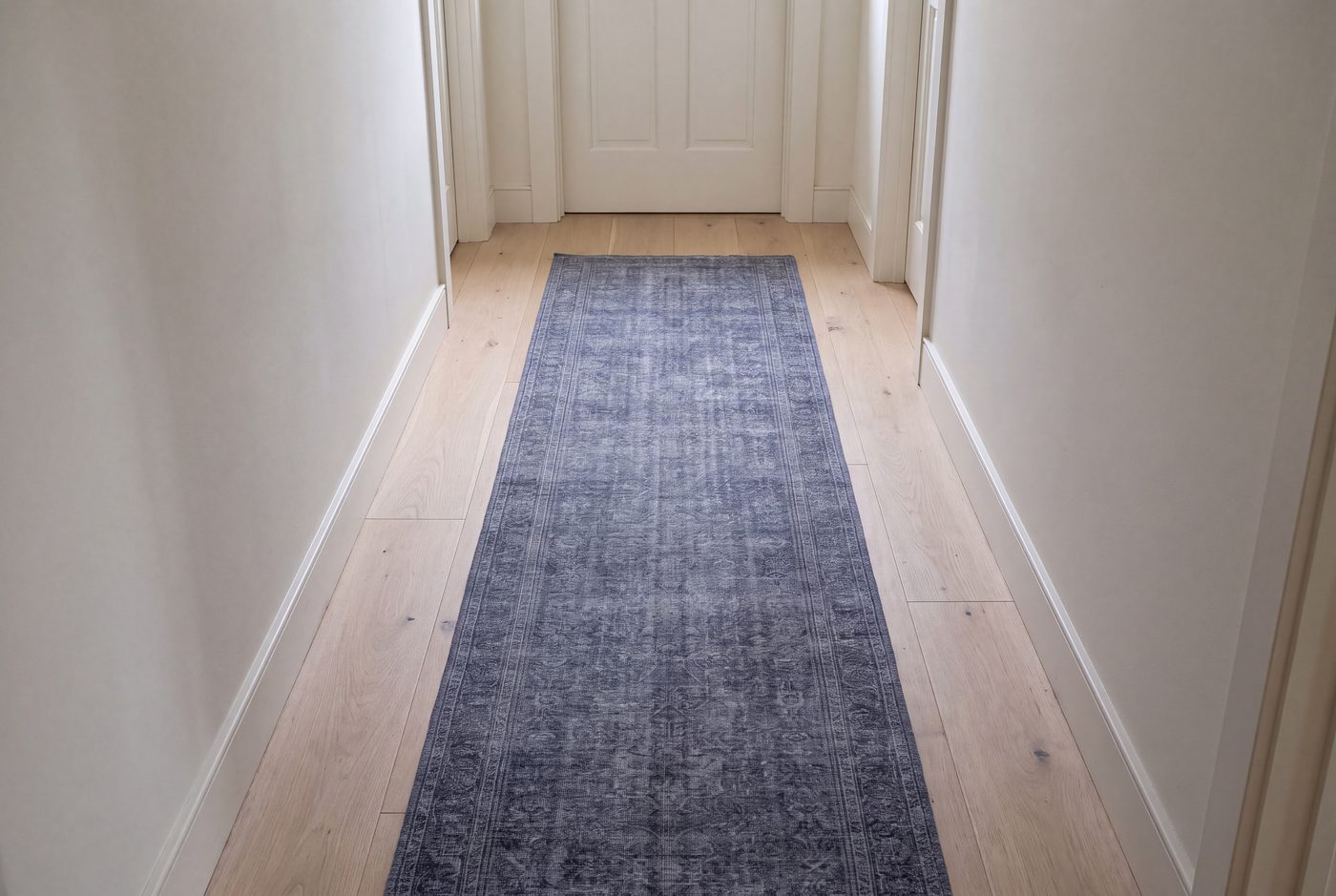
A runner is the one rug where the room is a corridor, so the sizing is about margins rather than about furniture.
The store's rule is 4 to 5 inches of floor showing on each side of a runner. Enough that the runner reads as deliberate, little enough that it still covers the walking line.
Width
Hallways are commonly 36 to 48 inches wide.
| Hall width | Runner width | Floor each side |
|---|---|---|
| 36 in | 2 ft 3 in | 4.5 in |
| 42 in | 2 ft 6 in | 6 in |
| 48 in | 3 ft | 6 in |
A 2 ft 6 in runner suits most halls. In a hall narrower than 36 inches, a runner leaves almost no margin and the rug reads as carpet, which is a reasonable choice as long as it is the one you meant to make.
Length
Leave 4 to 8 inches of bare floor at each end, and keep the runner clear of any door that swings into the hall.
A runner that stops short of the end of a hallway by a foot or more makes the hall look shorter than it is. One that runs the whole length wall to wall looks fitted rather than laid.
The practical constraint is what exists in the length you need. Measure the hall, subtract about a foot for the two end margins, and take the nearest runner at or below that.
Standard sizes, and what each one is for
| Size | Where it goes |
|---|---|
| 2 x 3 | Inside a front door, one person's landing space |
| 3 x 5 | A wider entry, or a spot where two people stand to take off shoes |
| 2 x 6 | A short hall, or alongside a kitchen counter |
| 2 x 8 and up | A hallway of any real length |
| 4 x 6 | An entry that opens straight into a room rather than a corridor |
What size should an entryway rug be? For the space just inside a front door, 2 x 3 is the standard and 3 x 5 is the generous version. For an entry hall you walk down, it is a runner and the length follows the hall.
What size rug in front of the front door? 2 x 3, set far enough in that the door clears it through the whole swing. Measure the arc, not the width of the doorway.
Which rug belongs in an entry
This is the rug in the house that takes the most dirt per square foot, and the choice matters more than the size.
- Flat and low pile. Deep pile holds grit and takes days to dry.
- Washable, because this one will need it.
- Grip. A mat that slides on a wet entry floor is a hazard rather than an inconvenience.
- Dark or patterned. A pale entry rug shows every footprint by the second week.
Synthetic beats natural fiber here. Jute in an entry meets wet shoes, and wet is the one thing jute does not take.
Shop washable rugs · Shop non-slip rugs · Shop 2 x 3 rugs
Doors, which decide more than the length
Check every door that opens into the hall, at its lowest point, before choosing a thickness.
A door that clears bare boards does not always clear a rug, and a runner that catches under a door gets dragged into a ruck every time the door is used. This is the most common reason a hall runner fails, and it is a measurement, not a judgment.
Inside a front door
The entry mat is doing a different job: it takes grit and water off shoes before either reaches the rest of the floor.
- 2 x 3 is the standard size for one person's landing space inside a door.
- Leave the door swing clear. Measure the arc, not the width of the doorway.
- Something flat and easy to clean. This is the rug in the house that gets the most dirt per square foot, and a deep pile holds every bit of it.
- Grip matters more here than anywhere. A mat that slides on a wet entry floor is a hazard.
Shop 2 x 3 rugs · Shop non-slip rugs
A long hall, and two runners
A hall long enough that no single runner covers it is better served by two runners with a deliberate gap between them than by one that stops well short at one end. Keep the gap even and centered on something, a doorway or a light, so it reads as a choice.